Seoul · Manila Wire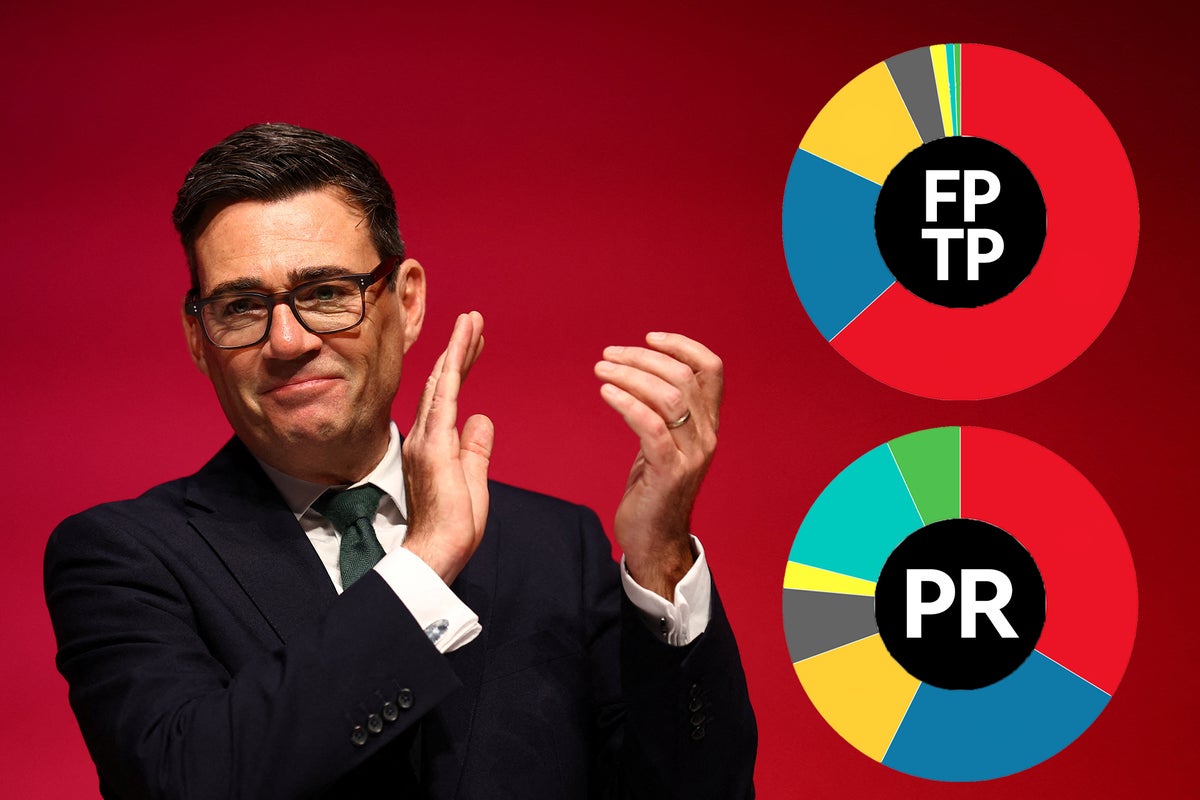
Andy Burnham has said that Labour will seek to change Britain’s voting system if it wins the next general election , in a move that could prove seismic for the future of British politics. Speaking at Labour’s conference for the first time as prime minister , he said that the government will launch a new commission on electoral reform. It opens the door to an historic change in the British voting system , a topic political leaders have long claimed is a priority – even though little has been done.
Mr Burnham said that it is “always in his mind” that he is Britain’s seventh prime minister in ten years, telling delegates in Liverpool: “We can’t succeed in the eyes of the world if we continue with the levels of political turbulence we have seen in recent times. “We will all have failed in our public duties if we carry on as we are and open the door of Number 10 to a divisive government on less than 30 per cent of the vote,” he added. Andy Burnham has said that Labour will seek to change Britain’s voting system (Reuters) Westminster elections operate under a first-past-the-post (FPTP) system, where the candidates with most votes in each constituency are elected.
This method has been criticised for not truly reflecting variations in political opinion. The debate has intensified following the 2024 election, where Labour took a landslide victory with just 34 per cent of the vote, making it the least representative result in history. The prime minister himself has previously supported a move towards a proportional representation (PR) model, saying at last year’s Labour conference that its time “has come”.
Winners and losers Moving away from FPTP is a radical proposal from a serving prime minister, not least because it served Labour so well at the last general election. Under a PR voting method the result of the 2024 general election would have been very different. Projections shows that Labour’s 411 seats would have nearly halved to around 220, decimating their 172 majority and resulting in a hung parliament.
The Conservatives meanwhile would have received around 30 more seats. But the biggest winners from a PR voting system in 2024 would have been Reform UK, gaining 93 seats as opposed to just five. This is followed by the Green Party, which would have boosted its seat share from 4 to 44.
These figures beg the question as to why Mr Burnham would choose to open the door to electoral reform. The answer likely lies in more recent polling, which has shown at points since the 2024 election that Reform could win a parliamentary majority with less than a third of the total vote share. While Labour has managed to buck the downward trend in popularity seen under Sir Keir Starmer, and overtaken Reform in voting intention for the first time since March 2025, these figures are always liable to change.
Switching to a more proportional system “would come at a price”, polling expert Sir John Curtice said. “Electoral systems vary in their degree of proportionality, but virtually any conceivable alternative would have treated Reform much more favourably,” he wrote in The Times . The biggest winners from a PR voting system in 2024 would have been Reform UK (PA) “While electoral reform might make it much difficult for a future Reform leader to become prime minister, it would make it easier for the party to establish the significant parliamentary presence it currently lacks.” Charlie Buckley, senior research associate at More in Common, added: “Under a first past the post system, you can have a good chunk of the vote but absolutely collapse in seats and maybe that's something that Labour want to avoid happening.
“Really it all depends on their electoral fortunes. If the next year of Burnham's time as PM goes really well, and Labour's lead gets more comfortable, then they might come to regret this announcement. “They'd be thinking they could have called an election and won a nice comfortable majority with with a new mandate.
But a proportional system wouldn't deliver that.” Which voting model to choose? There are several different PR models that are in use across the world, which would slightly change the picture of how a future election could look. However, each share the aim of mapping election results closer to the electoral vote share, unlike FPTP.
The Liberal Democrats, who have regularly backed electoral reform, called for the introduction of a single transferable vote (STV) system at the last election. This is used for Scottish council elections. Under this model, voters rank candidates by preference, and votes redistributed as candidates are elected or eliminated until all seats are filled.
Another commonly floated option is the additional member system, currently used to elect members of the Scottish Parliament. Under this model, voters cast two votes: one for a local representative and one for a party. This would return a local constituency MP.
Additional seats are then allocated regionally or nationally to make the overall result more proportional. This is the model used in Germany, where it more often than not results in coalition governments between different parties. This is currently the so-called ‘Grand Coalition’ of CDU, which holds the most seats, and the Social Democratic Party.
Mr Buckley said: “There's lots of proportional systems in Europe, and you say that the number of seats that each party has is more stable just because vote shares don't bounce around too much, and so a proportional system would keep things a bit flatter. “Every party would have a kind of floor and a ceiling. It's not possible to win massive majorities – or completely collapse and lose all your all your MPs – under a proportional system in the way that you can with first past the post.
“But the other side is the difficulty with forming a government under a proportional system, getting a coalition together of not just two but maybe three or four different parties.”
Source: The Independent